A Gray Ring Around the Eye? It Could Be More Than Just Aging
Most people pay attention to changes in their skin, hair, or weight as they get older. But few notice subtle changes in their eyes—changes that may reveal important information about their overall health.
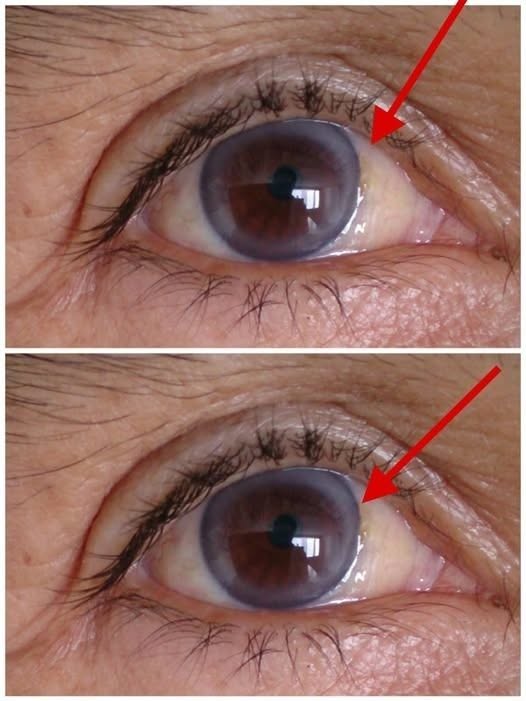
One of these changes is the appearance of a gray, white, or bluish ring around the colored part of the eye. This condition, known as Arcus Senilis, is often harmless, but in some cases it may be an early warning sign that should not be ignored.
What Is Arcus Senilis?
Arcus Senilis is a ring-shaped deposit of fats (lipids) that forms around the outer edge of the cornea, the clear front surface of the eye.
The ring usually appears:
White, gray, or bluish in color
Around the perimeter of the iris
In one or both eyes
Without causing pain or vision loss
Because it develops gradually, many people do not realize it is there until it is pointed out during an eye examination.
Why Does It Happen?
As we age, small amounts of cholesterol and other fats can accumulate in the cornea.
For many adults over the age of 60, this is considered a normal part of aging and is usually not dangerous.
However, when Arcus Senilis appears in younger adults, especially those under 45, doctors may recommend checking cholesterol levels and cardiovascular health.
Can It Be a Sign of High Cholesterol?
In younger individuals, the answer may be yes.
Research suggests that an early appearance of a corneal ring can sometimes be associated with:
Elevated LDL (“bad”) cholesterol
High triglycerides
Genetic lipid disorders
Increased cardiovascular risk
This does not mean everyone with Arcus Senilis has heart disease, but it may be a reason to discuss cholesterol testing with a healthcare professional.
Does It Affect Vision?
Fortunately, Arcus Senilis usually does not interfere with vision.
The deposits remain at the edge of the cornea and do not block light from entering the eye.
Most people experience:
No pain
No redness
No vision changes
No discomfort
For this reason, the condition often goes unnoticed for years.
How Is It Diagnosed?
An eye doctor can usually diagnose Arcus Senilis during a routine eye examination.
Using a slit lamp microscope, they can clearly see the characteristic ring around the cornea.