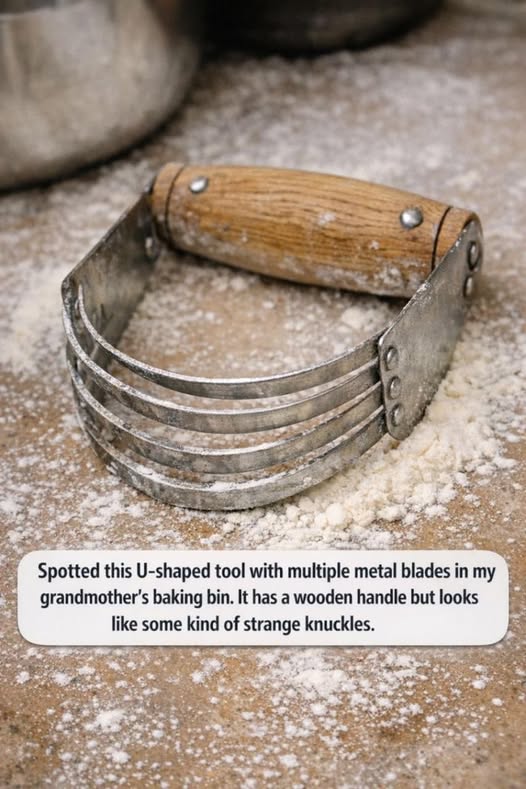
The blades, typically stainless steel, are chosen for their strength and resistance to rust. While they aren’t sharpened like knives, the sturdy edges allow the tool to cut through cold, firm butter without bending or breaking.
5. Pastry Blender vs. Knuckle Duster: Clearing Up the Confusion
At first glance, the pastry blender’s shape may resemble a Brass knuckles. However, their purposes and designs are entirely different.
Brass knuckles are designed to protect the wearer’s hand while delivering powerful blows. A pastry blender, on the other hand, is meant to apply gentle, controlled pressure to mix ingredients. Its blades are dull and designed for food preparation rather than force or impact.
6. Common Vintage Variations You Might Find in Grandma’s Kitchen
Vintage pastry blenders often come in a variety of designs reflecting the era in which they were made. Some have intricately carved wooden handles or decorative metalwork, from a time when kitchen tools were crafted with greater attention to aesthetics.
Older models might also vary in blade count, with some featuring as few as three blades and others as many as seven. Differences in spacing and curvature can offer slightly different blending experiences.
7. Key Clues That Confirm It’s a Pastry Blender
To confirm that the mysterious tool is indeed a pastry blender, look for these features:
A U-shaped frame with a wooden handle
Several parallel metal blades
Slightly curved blades designed for rocking motion
No sharp cutting edges
These characteristics clearly distinguish it from knives or other kitchen tools.
8. The Baking Jobs This Odd-Looking Tool Is Perfect For
The pastry blender excels at preparing doughs where fat must be cut into flour. It is perfect for:
Pie crusts
Biscuits
Scones
Shortbread
By quickly incorporating cold fat into dry ingredients, it prevents the dough from becoming warm or overworked, which can make pastries tough.
9. Modern Alternatives and How They Compare
Today, many bakers use modern tools such as Food processor or Stand mixer with paddle attachments to perform similar tasks.
While these appliances offer convenience and speed, they lack the tactile feedback and control provided by a pastry blender. Machines can easily overmix dough, resulting in denser pastries. For this reason, many bakers still prefer the traditional tool.
10. Caring for and Displaying a Vintage Pastry Blender
Maintaining a vintage pastry blender is simple. The wooden handle should be wiped with a damp cloth and occasionally treated with mineral oil to prevent drying or cracking.
The metal blades should be washed with warm, soapy water and dried thoroughly to prevent rust. Many people display vintage blenders in their kitchens as charming reminders of culinary traditions.
11. When a Quirky Kitchen Find Becomes a Family Heirloom
Finding a pastry blender in your grandmother’s kitchen can create a strong sense of nostalgia and connection to family traditions. It becomes more than just a tool—it represents generations of baking and shared memories.
Preserving and using it keeps those traditions alive, allowing you to continue the legacy of homemade pies, biscuits, and pastries for years to come.